

Why Create Blue Hour Photography
"Blue hour" refers to the darker stages of morning and evening twilight, when the sun sits well below the horizon and the sky takes on a deep blue color.
On a clear day, the transition between day and night can be a colorful spectacle - indirect sunlight tints the sky yellow, orange, and red before the blue hour sets in, the phase of twilight when blue wavelengths of light dominate.
Blue hour is a colloquial term, not a precisely defined one like dawn, dusk, or the three official phases of twilight. It refers to a state of natural light that occurs at daybreak - the pre-peak moment before sunrise - and again in the evening, during the final transition from dark blue sky into full darkness.
The blue color spectrum is most vivid when the sun is between 4 and 8 degrees below the horizon, which means blue hour overlaps with parts of both nautical twilight and civil twilight.
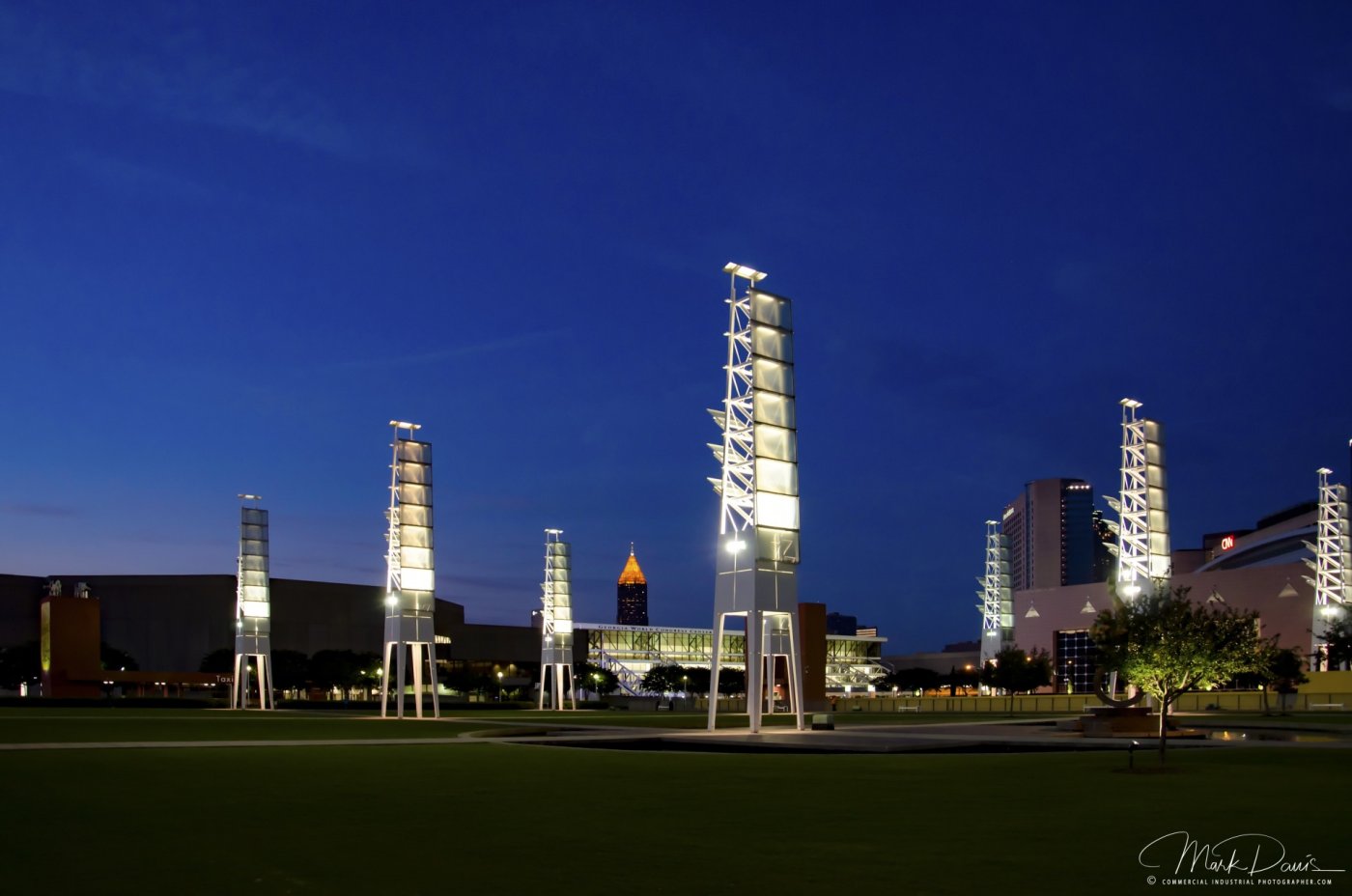
International Plaza, Atlanta - Blue Hour
Why Is the Light Blue?
The colors of twilight come from atmospheric scattering. As the sun's angle relative to the horizon shifts during the transition between day and night, the atmosphere filters out different wavelengths of light, coloring the sky in shifting hues.
During blue hour specifically, the sun is far enough below the horizon that the atmosphere scatters mostly short-wave blue light back down to Earth, while longer red wavelengths pass through and out into space.
How Long Does Blue Hour Last?
Duration depends on both latitude and season. Near the equator, where the sun crosses the horizon at close to a 90° angle, day-to-night transitions happen quickly, making for a short blue hour. At higher latitudes, the transition stretches out. Around 40° north or south - New York, for example - blue hour runs about 20 minutes in March. In Atlanta, it's closer to 10 minutes or less that same month.
In practice, the best blue hour photographs I've captured come from a window of roughly 3 to 12 minutes, depending on location and time of year - which means I need to be fully set up and waiting well before that window opens.
How I Select a Location for Blue Hour Photography
Blue hour is especially powerful for commercial and industrial clients because it combines saturated artificial lighting with deep, rich blue sky. The soft light and high color temperature during this window make it ideal for capturing artificial light sources - commercial buildings, plants and mills, cityscapes, bridges, and monuments.
Capturing it well takes real advance planning, since the window is far too short to figure things out in the moment. Long before I arrive on-site, I use a blue hour calculator to pin down the exact timing for that day and location, and to calculate the sun's angle. That determines whether I'm on-site at 5 AM or 6 PM - it depends entirely on the location's relationship to the sun. I'll never recommend blue hour photography for a location that isn't suited to it; doing so would just waste everyone's time.
The results are worth the effort. Blue hour photography is a popular choice for marketing commercial locations because it transforms an otherwise ordinary shot into a polished, advertising-quality visual - one that sets your business apart from competitors using only daylight photography.